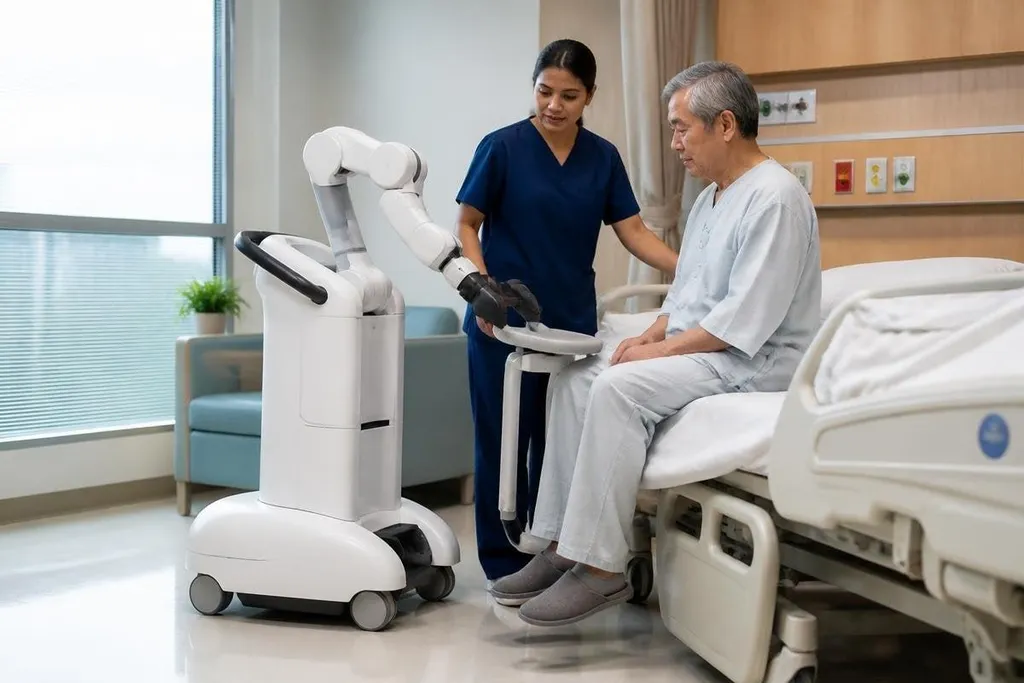
A nursing robot may lift equipment, move supplies, or help a patient sit up. The hard part comes after the demo: it must work safely beside people, fit into a care team, and help without adding more work.
This topic still lacks the product data needed for firm claims about price, staffing gains, or clinical results. So the useful question is what a future system must prove before a hospital should buy one.
Quick read
- A nursing assistant needs clear limits around lifting, movement, and patient contact.
- Staff need control, fast fault recovery, and records they can check.
- The open test is not a smooth demo. It’s safe work across a full shift.
What the robot would need to do
The first systems will likely handle tasks with a clear start and finish. A robot could carry linen to a room, bring supplies to a care team, or move a meal cart along a set route.
These jobs keep staff away from routine walking and carrying, while leaving care decisions with trained people.
Patient contact needs a higher bar. Helping someone stand or turn requires the robot to sense weight, motion, and sudden changes in balance. A small error can cause harm, so the system needs a safe stop, a clear handoff to a person, and a way to work when a sensor is blocked.
That makes the arm or mobile base only one part of the design. The control software must also show what the robot sensed, what action it chose, and why it stopped. A nurse should not have to guess whether a halt came from a person in the path, a low battery, or a failed camera.
The hospital is a hard place to automate
A care floor changes from hour to hour. Beds move, visitors cross corridors, carts sit in new places, and staff may need access to a room without warning. A robot that works in a clear test area still has to handle these changes without blocking doors or slowing an emergency response.
The robot also needs to fit existing work. If staff must charge it, clean it, move it out of the way, and report every minor fault, the task may shift rather than disappear. The buyer needs time records from normal ward work, not only a count of successful runs.
A nursing robot earns its place only if it reduces work during a normal ward shift without adding new checks for staff. For that test, Robot24 reports on named deployments, safety records, and limits shown in practice.
Privacy adds another concern. Cameras and microphones may help a robot find a room or detect a fall, but the hospital must control who can view that data and how long it stays available. Any system that records patient activity needs rules that staff and patients can understand.
What remains unproven
The topic has no evidence pack here, so no honest article can name a reliable price, runtime, error rate, or staffing result for future nursing assistants. Those figures will need published tests from named hospitals or labs, with the task, setting, and failure count stated clearly.
A useful test would run through ordinary care work rather than a staged route. It would record missed deliveries, blocked paths, emergency stops, battery changes, cleaning time, and staff calls for help. Patient-contact trials would need separate safety review and clear human supervision.
The strongest opposing view is that hospitals may get more value from tools that improve scheduling, records, or supply delivery before they buy robots that touch patients. That view has a practical basis: moving supplies has a smaller safety burden than lifting a person.
A buying checklist for nursing leaders
Use these questions when a vendor presents a pilot plan:
- Task limits: Which jobs can the robot do, and which jobs require a nurse or care aide?
- Human control: Can a staff member stop, redirect, or take over the robot at once?
- Failure records: Does the trial report every stop, missed task, collision, and call for help?
- Ward fit: How does the robot handle moved beds, blocked corridors, visitors, and emergency traffic?
- Data rules: What does it record, who can view it, and when is that data deleted?
- Total cost: Who charges, cleans, repairs, and moves the robot when it cannot finish a task?
I'd wait for those answers before treating a nursing robot as a staffing tool. The first useful system may be the one that moves supplies for months without interrupting care, while patient lifting remains under direct human control.